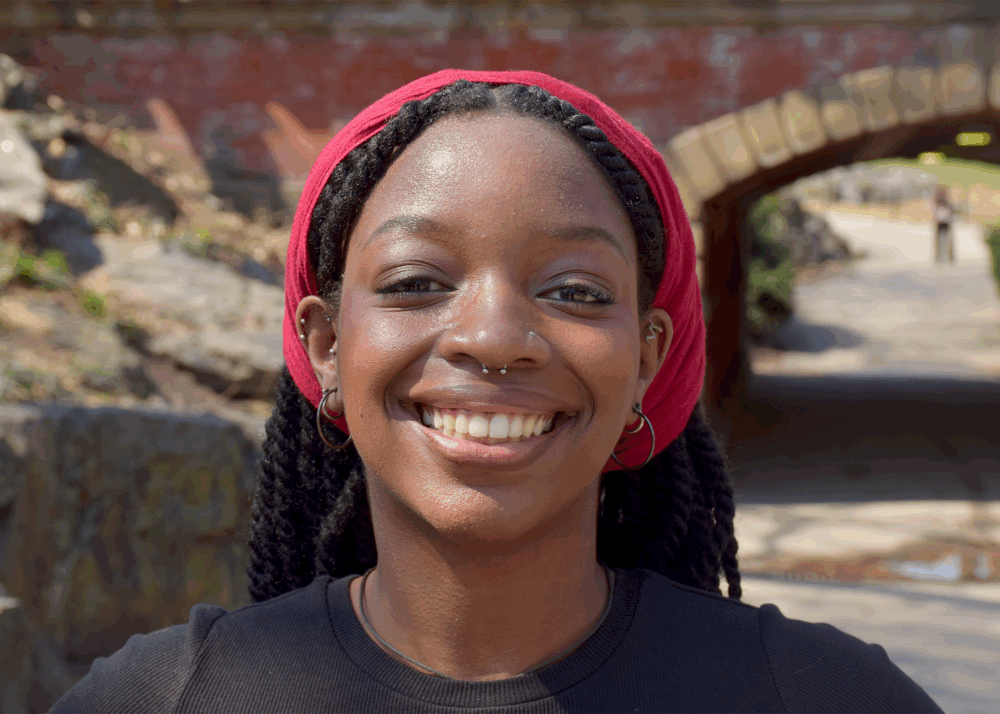
Reagan Grant, a Hunter College senior, turns lifelong love of storytelling into a Pulitzer Center reporting opportunity
Every morning before school, the television filled the room.
In a home just outside the Bronx, the sounds of News 12’s hyperlocal headlines echoed over breakfast. At night, the screen returned to ABC World News Tonight with David Muir.
Stories, packaged and edited. Stories, complete.
Reagan Grant, now a senior at Hunter College, learned to watch the world before stepping into it.
What she didn’t know then was that she was not just consuming the news – she was studying it.
For Grant, journalism would evolve into something more than information. It would become art.
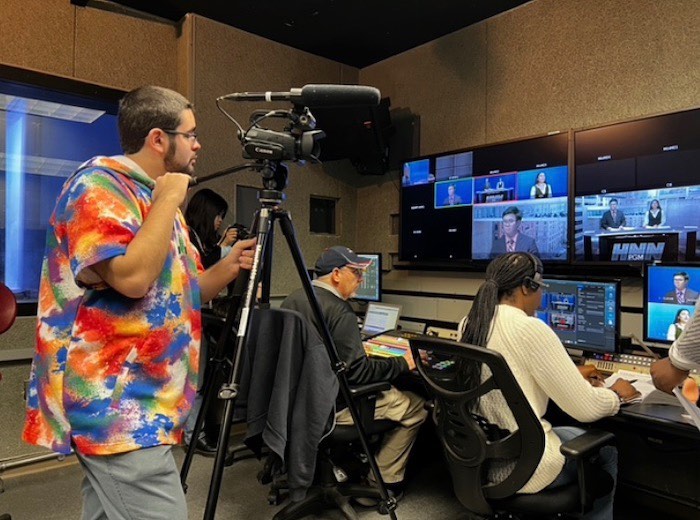
At Hunter, where Grant majors in media studies with a concentration in journalism while also pursuing a certificate in arts management and leadership, that idea has taken shape. As a Muse scholar, Grant immerses herself in creative spaces – music, performance and visual storytelling – all of which have influenced the way she approaches reporting.
“It feels like an art project,” she says. “Putting together a story and watching it all come together – it’s really satisfying.”
That intersection of art and storytelling became especially clear through her radio show, Raydioroom, where she interviews up-and-coming New York City musicians. There, she explores the layers behind creative work – life, culture and history – the same elements essential to journalism.
Recently, Grant has begun shifting beyond arts and culture and toward hard news. When applying for the Pulitzer Center Fellowship, she knew she wanted to report on communities impacted by hurricanes, places often overlooked in mainstream coverage.
Initially, she considered Puerto Rico. But as her research deepened, she landed on Jamaica as the place she most wanted to report on. Grant’s parents are both from that country in the West Indies, and many of her family members still live there.
“I thought it would be a beautiful opportunity not only just to do this reporting, but also to connect with my heritage,” says Grant.
When planning the pitch and narrowing her topic, one initiative kept popping up: the Jamaica Network of Rural Women Producers. Grant knew this was the organization she needed to report on.
“You never really hear about organizations like this, specifically led by women and also specifically led by women who live in rural areas,” says Grant.
People’s stories, their experiences, and their lives are what Grant wants to highlight, to be someone who can share their story and bring awareness. “People in the country get overlooked oftentimes,” she says.
While Grant has family members in Jamaica, she is actively trying to go in with no expectations, allowing what she learns on the ground to guide her.
Grant believes her biggest challenge will be getting around the island. “The roads in Jamaica are not good,” says Grant.
Grant hopes that reporting in Jamaica will help her grow not only as a journalist, but as a person. “I hope it builds empathy,” she says, “and inspires me to take on an even bigger challenge.”