
Professor Emmanuel Felton grew up with a keen interest in the world around him, but it wasn’t until Hurricane Katrina hit his hometown of New Orleans in 2005 that he considered the issues his own community was facing. The hurricane left many low-income Black communities displaced and permanently impacted by the poor emergency response.
“That really hit home for me,” Felton said, “to see how much inequality was still existing in our own country.”
A senior in high school, Felton realized the power of journalism to interrogate structural racism in American policy.
Despite the journalistic curiosity the tragedy had sparked in him, Felton would go on to major in finance at Emory University in Atlanta.
Felton initially thought he wanted to become a banker — an idea “which seems crazy” in hindsight, he said.
After college, he considered law. He took the LSAT and got a job at the Southern Poverty Law Center in 2010, where he worked with lawyers to investigate legal civil rights complaints in the South.
Felton enjoyed working with communities and being trusted with sensitive stories, but he couldn’t envision himself dealing with the legal technicalities of a court case for the rest of his life. He also didn’t see the potential for law to resolve the enduring racial issues in the United States. He did see that power in journalism, though.
And so, Felton began to explore a career in journalism.
There was one problem.
“I never wrote for a student newspaper, so I didn’t have any clips,” Felton said.
That didn’t deter Felton. He applied to Columbia University’s Graduate School of Journalism. In 2012, he moved to New York to attend the program’s investigative reporting track.
After graduating, Felton completed a yearlong education reporting fellowship at Columbia. In 2014, he landed his first reporting job at The Hechinger Report, a nonprofit news outlet focused on education.
“I took sort of a different path than a lot of folks,” Felton said.
At The Hechinger Report, he published a story about the lack of federal oversight of school desegregation efforts across the United States. The story, co-published with The Nation, won a James Aronson Award for Social Justice Journalism, an honor presented by Hunter College.
“What made that the perfect first job is I was able to do very ambitious journalism very early on in my career,” he said. “And I think that’s really set me up to have a strong career.”
Felton continued reporting on race when he joined Buzzfeed News in 2019. There, he wrote a widely circulated story on the experiences of Black police officers who were at the Capitol during the Jan. 6, 2021 riot; the story offered a unique, untold perspective of that day.
“It was really emotional to talk to those guys,” Felton said. “I was talking to them after what was one of the craziest days of their lives.”
In 2021, Felton was hired at The Washington Post as the newsroom’s first race and ethnicity reporter.
“It did feel like a moment of validation,” Felton said. “I never really thought I would work for a place like The Washington Post.”
With the resources of a major national newsroom behind him, Felton continued to pursue his passion for telling impactful stories on race and inequality. He worked at The Post for five years before he was suddenly laid off earlier this year, along with over 300 of the roughly 800 journalists at the paper.
“It was particularly hard hit on reporters of color, and everybody who covered race like I did,” Felton said. “I was the first — and I’m guessing, last — race reporter at The Post.”
Since then, Felton has continued to examine race and Black life in America as a freelance journalist.
His first book, “The Search for Black Mecca: Untold Stories of America’s New Great Migration,” is set to be published by HarperCollins in March 2027.
“In a lot of ways I’ve been writing this book since I was a kid,” Felton said.
The Great Migration, which took place from roughly 1910 to 1970, saw six million Black people leave the South for cities in the North and West. Felton’s book explores a more recent reverse migration of millions of Black people moving back to the South since the 1990s. Through a compilation of stories, Felton seeks to understand this migration and examine “how the North and West failed to become the promised land.”
Felton is already developing his second book project with the support of the Watchdog Writers Group Fellowship at the Missouri School of Journalism.
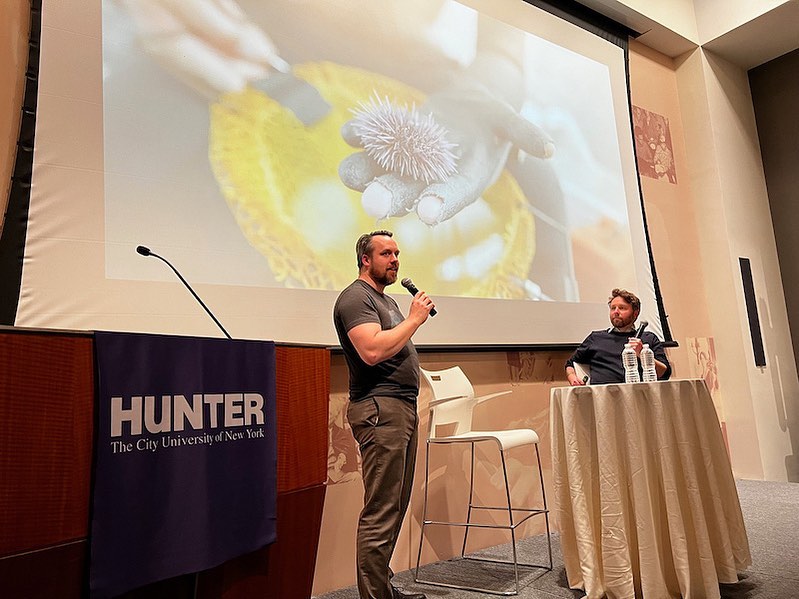
He is also teaching at Hunter College, where he first taught Investigative Reporting in 2020 and 2021. This time, he is helping students build healthier media consumption habits through News Literacy in a Digital Age.
Most of Felton’s students in News Literacy in a Digital Age are non-journalists. That excites him.
“I think it’s important for journalists to be teaching non-journalists,” he said, adding that journalism is about “informing the public and having a healthy democracy.”
Felton’s career in journalism has taught him the importance of being resilient.
His advice to students aspiring to enter the field echoes that lesson.
“If you really want to do it, you have to keep a passion for it, because there are many reasons not to do it,” Felton said.